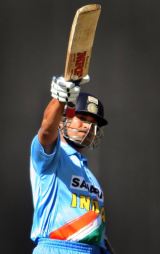
Friday, August 01, 2008

Honors even!

Day Two and Sehwag continued playing Lone Hand Luke, notching a double hundred in the process. And Ajantha Mendis took 6 wickets to justify the hype.

215/5 chasing 329 leaves the game in the balance. Sri Lanka have Mahela Jayawardene ( avg 102.5 at Galle) and Prasanna Jayawardene at the crease. Lose one wicket quickly and it is Advantage India. Dig in and play attritional cricket and the momentum will shift Sri Lanka's way.

India has, in its ranks, a rejuvenated Harbhajan Singh. - bowling round the wicket to right handers.Extracting turn and bounce and generally looking like the guy who took 32 wickets in 3 Tests against the Australians.

Anil Kumble is yet to get amongst the wickets but I wont discount him - if the wicket keeps being up and down, Sri Lanka have to bat last on a wearing surface.

India's biggest worry right now is that Rahul Dravid no longer has the presence at the batting crease as he once did.

Bad form? Maybe, but the more I see Dravid, the more he looks like a batsman playing from memory - his 93 at Perth and 100 at Chennai notwithstanding.

And this has been evident from that scratchy 12 at the Oval.

If he cannot turn his form ( and mindset) around by the time this season is over, India will have to make the tough call on his career!

Thursday, July 31, 2008

Not too shabby!

BAW Mendis 14-1-74-2
M Muralitharan 8.3-0-39-0

India RR 4.8.

Virender Sehwag 128*

All this with half the day's play lost and by a team walloped in the first test by an innings.

An up and down wicket with the odd ball bouncing more than usual, a mid order wobble and yet, at the end of the day's play, India ( fielding an unchanged side) have done all that was required of them - won the toss, took the attack to the bowlers, put on a decent first day score.

And all this on a sluggish outfield.

The portends for tomorrow - get a score in the vicinity of 350 ( or higher) with the wicket staying up and down and Sri Lanka batting last and the pressure ( because of India's rate of scoring) will be on Sri Lanka.

Which is not necessarily a bad thing :)

Wednesday, July 23, 2008

Huh?

Test discard Faisal Iqbal could be handed a ban or a hefty fine if the Pakistan Cricket Board decides to take disciplinary action against him for appearing in a Twenty20 tournament in Florida featuring players from the rebel Indian Cricket League.
Will it follow that the BCCI suspends Md. Azharuddin's pension since he partook in the tournament also?

And will the BCCI please issue show cause notices to messers Sharad Pawar, Inderjit Bindra, Ratnakar Shetty, Dilip Vengsarkar and other BCCI office bearers for maintaining contact with him?


Addendum :- Since Azharuddin is not on the BCCI payroll, the BCCI has no locus standi on his actions. Ditto the PCB.

Just one question

With all the hoo-haa about Zimbabwe doing the rounds, I have one question to ask

My question is - is the ICC going to block the monies due to China and Hong Kong because of China's veto?

Mischief

8 letters that could stand in for CricInfo!

How else would one describe this report and more specifically, this line

The Indian board sees "no harm" in Pakistan hosting the tournament in September, Niranjan Shah, the BCCI secretary, said on Wednesday.
Could someone from CricInfo's editorial board explain the quote no harm unquote or does journalistic license ( like the poetic one) allow Cricinfo "staff" to get away with murder?

More gems from the "Cricinfo staff" here, here, here and here.

PS:- Here is what the BCCI President elect ( and one of the VP's in the BCCI set up) Shashank Manohar had to say
"I don't want to speculate anything. Our view will be expressed only after hearing the voice of the other nations", he said.
Surely the BCCI President elect's thoughts are more reflective of the BCCI's stand than the Secretary's ( and never mind everything else Mr Shah had to say( "Our Indian team had taken part in the Asia Cup without any incident. Besides, the report of the ICC's security consultants, which was presented during the briefing in Dubai (on Sunday) was positive. So the BCCI sees no harm in Pakistan hosting the tournament."), however reasonable it was), no? Or is the desperation to get more eyeballs driving Cricinfo to manufacture headlines?

On Technology - 2

Dug up an old article from CricInfo

Steve Bucknor, a member of the ICC's elite panel of umpires, has complained that television production companies are misusing technology to make umpires look bad and key players look good.

Bucknor has revealed he has encountered instances of TV personnel maneuvering images to influence the flow and outcome of matches. "It has been known to happen where the technology has been used to make umpires look bad," he told reporters on Friday. "Mats [the line graphic used to adjudge lbw decisions] have been moved, balls have disappeared, ball hitting the bat and only coming up into the fielder's hands, but between the bat and the hand, no ball is found and you are told, 'Sorry, we don't have that clip, we can't show it'.

Bucknor, who has stood in a world record 111 Tests and four World Cup finals, as well as officiated 139 one-day internationals, noted he was speaking from personal experience. "It has happened; I've been in a game when it has happened," he said. "Sometimes nothing is shown because the batsman was a key batsman and getting out at that stage would have made life very difficult for that team. It all depends on who is operating the technology. I've been told that this ball is the one with which the batsman got out, but the one that is being shown is not the same one he got out with. It has been known to happen. When these things are happening, it makes life extremely difficult for the umpires. Who do you trust from there on you don't know."

Although he admits that there is a place for technology in the game and would like to see "a little bit more", Bucknor said the misuse of the technology is eroding the trust between umpires and players. "In the beginning of my career, umpires were trusted. When umpires said not out, the man was trusted, so they would say he is a good umpire and nobody questioned him. Today, the technology shows up his mistakes, and makes life a little bit difficult for umpires, especially when it has been known to happen that technology has been used to make umpires look bad."

and here is the ICC response

"Umpires are always defensive about their own decisions," said Dave Richardson, the ICC's general manager - cricket, before insisting that technology was there to help, not hinder officials, by sparing them from the intense scrutiny that surrounds even the most marginal of bad calls.

"I often point to him [Bucknor] as a very good example of why we need to give technology a go," said Richardson. "He's done particularly well this year. After not a great year last year, he's averaging around 96% of his decisions being correct, and yet he's made one or two decisions which have come in for terrible criticism from the media and from fans writing in to us."

Richardson's views were backed by Steve Norris, head of production at Ten Sports. "I am very surprised to know what Bucknor has said," Norris told PTI. "I have been in this field for 20 years and I have never come across such a thing. It just doesn't happen. There might have been technical mistakes but that is absolutely human error which batsmen, bowlers and everyone does."

Brian Murgatroyd, the ICC's media and communications manager, said extending the use of technology was an issue which needed to be discussed and debated from all perspectives. "From that point of view, I guess Steve has contributed to the debate," he said. Asked to comment on Bucknor's remark that production crews often failed to provide crucial frames, Norris said "it is a television thing. Normally there are 25 frames per second. What Bucknor is talking about we call 'between frames'."

"People must remember that things like Hawk-Eye, Strike Zone [the imaginary mat projected stump to stump for leg before decisions] were never designed for umpires," said Norris. "These are for viewers' appreciation ... The Hawk-Eye is 90 percent accurate, that is what they [the creators of the technology] claim.

Here is what I had to say about the use of technology on the field of play.

For all the talk of the three referrals and how it did not fly in England but is now de jure, the fundamental question remains unanswered - how does the ICC take away the bias that creeps in ( either inadvertently or maliciously) in cricketing broadcasts?

PS:- Related articles from CricInfo

"The more technology ICC uses, the more they hand over responsibility to the television producer. The position of the mat is the producer's responsibility and that can definitely be tampered with," said Harsha Bhogle, the Indian broadcaster. "Even coming to TV replays that the third umpire sees, suppose there is a 24-camera coverage, you might have 8 cameras dedicated to recording replays. The pictures you get depend on the skill of the cameramen and the skill of the editor in choosing the right replay to show, and finally the director taking a call to show it. If the director is either incompetent or biased, then that is a problem because he controls what the third umpire sees."

One broadcaster, speaking on the condition of anonymity, concurred with Bhogle and even added that, "there have been suspicions in the past that producers, especially from certain countries, have been a touch too patriotic, and have withheld replays that went against home teams." The problem will exist as long as the ICC use television companies as allies in the decision making process. Then there is the in-built economics of production itself: for the television producer, the primary aim is to produce the best quality broadcast at the lowest possible cost. This means that he would be reluctant to add a camera at midwicket, for example, if it did nothing to increase the quality of the viewing experience, even if it helped give the umpire a better view.

---

The increasing move towards technology though needs to answer one other fundamental question. If an umpire's decision is challenged by a batsman, let's say for a slip catch, and the replay for whatever reason, is inconclusive, will the batsman win his appeal? Or will, in the absence of firm evidence to the contrary, the umpire's decision stand?

I believe we need to move ahead and use technology wherever possible but we need to be a little wary about outsourcing justice beyond a point.

Thursday, July 17, 2008

The Indian Market

Sometime ago. I had written this

1. Why is it so difficult for the rest of the world to understand that their opinion vis a vis the IPL matters not a jot! The only people who can make or break the IPL are the Indians. More specifically, the Indians residents in the 8 cities that make up the ICL teams.
and
4. The BCCI and the individual franchises are going to have a pretty hard time selling the game to their constituents. And not because of the marquee names. The ICC World XI was full of marquee names and we all know what happened to the Super Tests. For the next two years, with the team rosters already set, I wonder what the degree of attachment will be for a team comprising of fewer local and national players and more of international players.
thought that I harked back to when I red the following paragraph from Andrew Miller's article on the EPL
Most crucially of all, the English time zone (as football has discovered) is tailor made for the Indian market, with matches beginning at 9.30pm India time and ending shortly past midnight. Set against that, however, is the difficulty of persuading people to watch. The beauty of the IPL was the richness of the talent in each side - with only eight franchises to choose from, the best players were on show in each and every game.
Now, from a County and EPL perspective, the second point ( of selling the game to their constituents) is a non starter - because of the way the county teams and structured with their foreign imports and the Kolpak players.

What is crucial is the first point.

That the EPL will be a success is not in doubt - 5 years of domestic 20/20 cricket has shown that there are enough patrons willing to spend money and time to have 3 hours of solid entertainment.

But for the EPL to become a real money spinner, the Indian market becomes crucial - get enough eyeballs in India and you have the advertisers queuing up to pay top dollar - unlike the IPL where the English viewership did not make a significant difference to the overall revenues of the enterprise.

And there are plenty of mitigating factors. Here are a few
  • Season 2010 sees England host the West Indies and Bangladesh ( with Australia thrown in for good measure). India, in the meantime, will play the Champions Trophy and the Asia Cup along with the IPL as a lead up to the inaugural EPL.Season 2011 has the World Cup on the sub continent followed by India's tour to England for 4 tests and 5 ODIs.Because of the way the first two seasons are structured, even if the ECB and the BCCI are willing, Indian player availability is suspect.And if the Indians don't play, Indian spectators don't watch - simple as that.
  • Because of the structure of the FTP and because of the Champions Trophy in 2010 and the World Cup in 2011 ( along with the IPL), a lot of the advertising money will be concentrated on these three events. Indian advertising revenue for the EPL - little to none.
  • 57 games in 25 days with a TV window of between 9:30 PM and 12:00 AM - even if India is agog with EPL fever, how many eyeballs and for what games?
  • Ownership of the teams is by the Counties, unlike the IPL where the free market forces are the final arbiters. Given that there will be a profit sharing mechanism in place ( 18 counties ahead of 9 city based teams is proof enough that there will be a profit sharing dynamic with all of the counties getting a piece of the pie) and given that counties are given annual stipends (?), and given that there will be a salary cap in place, where is the motivation for the counties to field the best teams or to be ultra competitive? I mean, if a second division team stands to earn twice what it does currently just by showing up, what is the motivation to do anything more - just cap the costs to the barest minimum, bring in the money allocated by the ECB and show profits.
  • The BCCI - The ECB has been playing hard ball with English player participation in the IPL. Count on the BCCI to reciprocate in kind.And, if the BCCI can persuade the BCB and the PCB to join in, the entire Asian contingent in the stands goes. And with it goes the noise and the color and the vibrancy Asian crowds bring to the cricket field. And that is just the crowd factor.TV rights is another sphere where the BCCI can screw the ECB. And screw it will.
  • Zimbabwe - the ECB reversed it stand on the Oval test of 2006, the Indians bailed them out vis a vis the World Twenty20 next year, god knows what other compromises were made - there is a blow back waiting to happen.
  • Allen Stanford - and his annual quadrangular featuring the West Indies and England to be held in England. Try fitting all of that ( in addition to the FTP) in a cricket calender that extends from May until August ( September would mean clashing with the other EPL).
I am all for the ECB to make money- that should never be the monopoly of a select few.

But now is a good time as any to remind ourselves that when Jagmohan Dalmiya took over as the head of the ICC in 1996, the ICC was nearly 15-20,000 pounds in the red.

Tuesday, July 15, 2008

No extra webbing - 2

Remember the controversy over the "extra webbing" on MS Dhoni's gloves during the CB series? If not here is the recap

IN a dramatic twist to yesterday's tri-series clash, Indian skipper MS Dhoni has had the gloves he caught Adam Gilchrist with confiscated during the game by match referee Jeff Crowe.

The unprecedented move by Crowe - the former New Zealand Test captain - followed suggestions from former Australian wicket-keeper Ian Healy during Channel Nine's commentary that the webbing on Dhoni's gloves was illegal.

Imagine my surprise then when I saw the following images on the Cricinfo website


Different strokes for different folks?

One small step

in the right direction

Meanwhile, the list of 20 bowlers - a copy of which is with HT - is expectedly dominated by off-spinners. It may be recalled that on February 6, HT had reported that the list of bowlers with suspect actions was being compiled and 13 bowlers had been identified till then. The bowlers, who were identified by former India captain and the head of BCCI's umpires' wing S Venkataraghavan, underwent a three-week rectification programme under the vigilant eyes of Venkataraghavan and NCA director Dav Whatmore. While some of the bowlers have been cleared, those who still needed assistance are currently stationed in Bangalore.

Not only has the BCCI taken the effort to identify players with suspect actions, but has also taken steps to help rectify the problem instead of discarding the players by the wayside ( as was the norm previous;y).

And to top it off, the NCA is finally functioning as a multi dimensional, multi role organization after being dormant for all these years.

Joy!

Monday, July 14, 2008

Something's not right

A sample taken from random testing at the inaugural season of the Indian Premier League has tested positive, IPL commissioner Lalit Modi has confirmed to Cricinfo. This is the first step of the verification process, Modi said, and there are several stages before a player is deemed to have failed the test.

The tests were carried out by IDTM, a Sweden-based independent agency, in accordance with World Anti-Doping Agency (WADA) standards after the IPL adopted the ICC's anti-doping code. The samples were forwarded to a WADA-approved laboratory in Switzerland for testing. "Two days ago the IPL received a letter from the Swiss lab, mandated by WADA, which said one sample had tested positive," Modi said. "The IPL will follow set procedures from now on."

The first step, he said, is to match the identity of the player with the sample. Next, the player's form, filled out before the match, will be scrutinised for any pre-declared or prescribed drug by the IPL medical committee, consisting of an IDTM representative and Dr Anant Joshi; if that matches the drug found in the sample, the matter ends there and the player's name won't be revealed.

If the medical committee investigation reveals the player had not applied or been granted an exemption for using the drug found in the sample, the player, the concerned IPL franchise and national board will be informed in writing of the positive test that violates the anti-doping code. The player has the right to request that his 'B' sample [supplied at the same time as the one that tested positive] be sent for analysis, which he and his representative can attend along with an IPL representative.

If that too is positive, the matter will be taken up by the IPL's drugs tribunal, comprising of Sunil Gavaskar, Dr Ravi Bapat (ex-Vice Chancellor of Maharashtra University of Health Sciences) and lawyer Shirish Gupte. The tribunal will study the issue and take a decision in accordance with the code. "This is just the procedure," Modi said, "as of now we are at the first stage where one sample has tested positive. The issue is now with the IPL's medical committee. The identity of the player will matter only after we check on the pre-declared drugs."

----

The IPL compared the result from the WADA-approved laboratory in Switzerland [that tested the samples] with the data collected by IDTM, the Sweden-based independent agency that organised the tests, and confirmed Asif as the player whose sample was positive.

The IPL medical committee then scruntinised the form filled by Asif prior to the test to verify but he had not applied for or been granted an exemption for the drug found in the sample. "It was also checked if Asif had applied for and was granted a Therapeutic Use Exemption (TUE)," an IPL release said. "It was found that Asif had not applied for a TUE. A note in writing has been sent to the player and his home board and to the franchise on the findings."

---
The Indian Premier League compared the result from the WADA-approved laboratory in Switzerland with the data collected by IDTM, the Sweden-based independent agency which organised the anti-doping testing in accordance with World Anti-Doping Agency (WADA) standards, to confirm the player in violation is Mr Mohammad Asif,' the IPL said in a statement.
---
Procedurally, the IPL/BCCI have done everything that is required of them - having followed the procedures to a T. Now contrast that with this
A representative of the World Anti-Doping Agency in Pakistan on Monday slammed Indian Premier League organisers for prematurely identifying the player who failed a dope test during the tournament.

The IPL on Monday named Pakistani pacer Mohammad Asif as the player who had failed the dope test but as per WADA rules the player could not be identified until his 'B' sample is also analysed.

"The announcement by the IPL is a clear violation of WADA regulations," Dr Danish Zaheer, who also heads the Pakistan Sports Medicine Association, said.

He was of the view that the IPL has violated the World Anti-Doping Code by prematurely disclosing Asif's name.

"The Indian Premier League organisers have made a deviation from the WADA code as IPL should not have made a public disclosure until Mohammad Asif's 'B' sample was checked in the presence of Asif or his legal and medical representative," Zaheer said.

He referred to the result management code of WADA paragraph 7.1, 7.2 and 14.2 regarding public disclosure that provides that athlete be given ample time and opportunity to prove his innocence before public disclosure.

---
Director cricket operations PCB Zakir Khan has confirmed that Mohammad Asif was tested positive for a banned substance during random testing on May 30 during the Indian Premier League (IPL).

Zakir Khan told media at the Gaddafi Stadium that after receiving a written statement from the Indian Cricket Board, the PCB informed Asif of his dope test result.

He said that now Mohammad Asif has a right to challenge his B sample but he has so far not intimated to the Board.
---
Here is the WADA Result Management code ( check Section 7 pg16) and the World Anti-Doping Code ( check Section 14.2 pg 41) - I don't see anything that the IPL has done that contravenes the WADA codes.

It just does not add up!

PS:-

July 15: The banned substance found in Mohammad Asif’s dope test sample during the IPL was nandrolone, a high level Pakistan Cricket Board source has said.

Nandrolone is an anabolic steroid which Asif is likely to have consumed for his elbow injury. "It was not clear whether the bowler consumed it orally or if it was injected into his body.

"However, his positive result is above 6 milimole (measuring unit)," the source further said.


Old Summer Whine!

Then

The Indian cricket board yesterday rejected a request from England to change the venues for this winter's tour to the country.

England, due to tour India next March and April, had hoped to persuade the Indian board to shift the three Tests from the proposed venues of Ahmedabad, Nagpur and Bombay.

Although satisfied with Bombay, England prefer to play other matches in traditional centres like Delhi, Bangalore, Madras and Calcutta which have enough hotels to accommodate a large contingent of media and fans.

and now
The Brabourne experience will, however, be the undoubted highlight of an itinerary that has not pleased England's representatives. A statement read: "The ECB are disappointed that, despite their representations, the itinerary doesn't offer the thousands of supporters who follow the England team abroad, the opportunity to experience more of the great cricket grounds of India."

Thursday, July 03, 2008

The politics of confrontation

A wind blows from the east

Mihir Bose


Almanack home
1997 home


One-day internationals with Sachin Tendulkar draw huge crowds and bring huge money © Getty Images

Napoleon's warning that the world should beware when China awakes has, in the last year, been translated into a wholly unexpected warning for the cricket world from another part of Asia - the Indian subcontinent. It has happened, not on the cricket field, but off it. On the field, the subcontinent has been a major power since 1971, when India won back-to-back series away from home in the West Indies and England. Sri Lanka's recent rise has merely confirmed this trend: three of the last four World Cups have been won by the subcontinent.

However, it is the money that the subcontinent can now generate through cricket that is posing a challenge to the established power centres. It is transforming the traditional image of the subcontinent as the land of magical spinners, wristy batsmen and (in Pakistan) devilish fast bowlers, into a place whose rich cricket administrators can dictate the future of the game.

This sounds like a contradiction. With a combined population of well over a billion, South Asia remains one of the poorest regions of the world. But while much of this population lives just above the poverty line, there is also a well-off nation within the poor one. Six hundred million Indians may not get more than a square meal a day; but India also has 250 million people - almost the population of the United States - with a standard of living not far behind that of the West. Inside the subcontinent's thin man, there is a fat man trying to get out - and desperate to advertise his wealth.

A hint of this had come in 1993 when India, Pakistan and Sri Lanka, after the most fractious meeting ever of the International Cricket Council, won the right to stage the 1996 World Cup. The key to victory was the way the three countries got the ICC's Associate Members - hitherto treated much as the Soviet Union used to treat its eastern European satellites - on their side by promising them £100,000 each. England, who believed they had a gentleman's agreement guaranteeing them the 1996 tournament, had offered £60,000 each, and throughout the meeting seemed to assume this was yet another cosy old boys' gathering. The Asians wheeled in politicians and lawyers and treated the event as if it were an American presidential convention. They outflanked England and won a rich prize. How rich only became evident when the 1996 World Cup began.

Unlike the Olympic Games, or soccer's World Cup and European Championships, the cricket World Cup is not an event owned by the international authority that runs the game. The country staging it, in effect, owns the competition. In five previous World Cups this had made little difference: the host country had made money, but not so much as to raise eyebrows. The 1996 World Cup changed everything.

As soon as they had won the competition the hosts set about selling it. Their biggest success was auctioning the television rights for a staggering $US14 million, using a hitherto unknown agent of Indian extraction based in the United States, Mark Mascarenhas. The UK rights alone fetched $7.5 million, compared to $1 million in 1992. In addition the tournament was marketed on a scale never before seen in cricket. There was an official sponsor for every conceivable product, including the official World Cup chewing gum.

A few years earlier, the world's most famous soft drink manufacturers had not even been allowed to sell their products in India. Now Coca Cola and Pepsi Cola battled it out to be the official drink supplier. Coke won - but they had to pay $3.8 million, more than Benson and Hedges paid the Australians to be the main sponsor of the 1992 World Cup. That role went to Wills, the Indian tobacco offshoot of BAT, who paid $12 million.

The organisers loved the rivalry. They were aware that they could keep all the profits, once they had met their expenses, which included a fee of £250,000 to each of the competing Test countries. This amount did not even cover the expenses of some of the teams, but the hosts pocketed a profit of almost $50 million. Contrast this with the 1996 European Championship of soccer in England: where UEFA, as owners of the championships, made a profit of £69 million, England, the hosts, made a loss of £1.7 million.

It could be argued that the cricket administrators of the rest of the world were naïve to agree to such an arrangement. But in five previous World Cups nobody had sought, let alone achieved, such commercial success. Not everyone on the subcontinent foresaw it. The Sri Lankans, co-hosts of the tournament along with India and Pakistan, clearly had doubts: they did not agree to underwrite the costs, so did not participate in any of the profits.

The man who drove the commercial juggernaut was Jagmohan Dalmiya, secretary of the Indian board. He hails from the Marwari community of India whose business skills are both feared and respected

The man who drove the commercial juggernaut was Jagmohan Dalmiya, secretary of the Indian board. He hails from the Marwari community of India whose business skills are both feared and respected. The joke in India is that a Marwari can do business with a Scotsman and a Jew and still make money. The other joke, less flattering, is that if you should see a Marwari and a tiger together in the jungle, you should shoot the Marwari first. Even within the Indian board, there are some who are less than enamoured of Dalmiya. He was responsible for the opening ceremony in Calcutta, which was widely regarded as a disaster. But few have ever had doubts about his financial acumen.

Had the subcontinent been content with its World Cup killing, this would have been an interesting marketing story. What has made it an explosive cricketing one is the use the triumphant administrators made of their new-found financial power. They launched a two-pronged attack. The short-term aim was to make Dalmiya chairman of ICC. The long-term aim was to make sure that the subcontinent was at the centre of the cricket world.

The first battle came to a head during the annual ICC meeting at Lord's in July. With Sir Clyde Walcott coming to the end of his term, Dalmiya stood for the chairmanship, along with Malcolm Gray from Australia and Krish Mackerdhuj of South Africa. On the basis of a simple majority, Dalmiya, bolstered by the Associate countries, had the votes. But he did not command the majority of the Test-playing countries. The rules were less than clear, but the Indians, having taken the advice of a QC, contended that the election should be decided by a simple majority. Walcott argued that any successful chairman must have the backing of a two-thirds majority of the Test-playing countries: six out of nine. Underlying this was concern about what a Dalmiya chairmanship might do. Before the meeting, his thoughts on the future development of the game had been extensively quoted in the media. These included a suggestion that Tests should become more like one-day matches, with every innings limited to certain numbers of overs.

The meeting ended in stalemate. Various suggestions to resolve it, including a second term for Walcott or for future chairmen to rotate country-by-country, were left hanging. But as 1996 turned into 1997, intense negotiations suggested a possible compromise framework: a rotating short-term chairmanship (probably starting with Dalmiya), a new, authoritative executive committee, less power for the Associates. In the meantime Walcott carried on. The wider issue remains: how can ICC accommodate the new power? The Asians want to be at the top table. As one administrator put it: "We do not want to come to Lord's for ICC and just nod our heads like little schoolboys as we used to. Now we come with fully prepared plans and want to be heard as equals."

It is interesting to note that on this issue the old racial solidarity displayed when ICC tackled apartheid in South Africa no longer holds. In subcontinental eyes the West Indies are part of the old power structure, marshalled by England and Australia. Cricket has evolved no mechanism to cope with a changing situation. In 1974 the world football body FIFA elected the Brazilian, Joao Havelange, as president. He defeated Sir Stanley Rous, the symbol of the old European control, by shrewdly aligning the footballing centres of Latin America with the emerging countries. The Europeans have never been totally reconciled to him, but coexistence has been possible because Europe is still the economic powerhouse of the game. New centres such as Africa have come through and football has flourished.

Cricket has never had to cope with a Havelange. The ICC may no longer be a creature of the MCC, but its offices are still at Lord's. And the two men who have presided over it since the MCC President stopped being automatically head of ICC, Sir Colin Cowdrey and Sir Clyde Walcott, have been old-world figures. In such a setting, Dalmiya is seen as a parvenu out to wreck the game. As one (non-Asian) administrator put it: "Dalmiya, personally, may not have been acceptable, and his tactics of trying to storm the citadel were probably wrong. But we have to realise that the subcontinent is a major power in world cricket. The television market there alone makes it very important."


Dalmiya may have been seen as a parvenu, but he shook up cricket's old power equations © AFP

The fear is that if Asia is not kept sweet, it could use its money to seduce Test-playing countries into something like a rival cricket circuit. Here cricket's very structure could be a help. The game is still organised in the 19th century way. Apart from the World Cup every four years, and England's regular series with Australia, there are no fixed dates on the calendar. This means entrepreneurs can, almost at will, construct lucrative cricket tournaments. In 1996 the cricket boards of India and Pakistan, together with Mark McCormack's company TWI, staged five one-day matches in Toronto, the first time official internationals had been played in North America. The enterprise was underpinned by the ability to sell television rights, at $1 million a match, to a satellite company keen to broadcast to the subcontinent.

In May 1997 the Indians are planning to hold a tournament to celebrate 50 years of their independence. Traditionally, the idea of playing in India in May was considered preposterous. But in order to avoid the worst of the intense heat, the Indians intend to start matches at about 3.30 in the afternoon and play until midnight. The Indians can contemplate this because the profits of the World Cup have helped them install lights in most of their grounds. And they know the TV rights will fetch large sums of money. Already, cricket in Sri Lanka from August has cut into the latter half of the northern summer, which used to be the exclusive cricket preserve of England. A tournament in May will be another dent.

The end result could be a far more powerful ICC - more like FIFA or the International Olympic Committee than the present small-scale set-up consisting of David Richards, the chief executive, a couple of assistants and a few phones. The subcontinent may not even want such an outcome: its bid for power should be seen as more akin to the barons at Runnymede extracting concessions from King John. But just as the Magna Carta led to consequences undreamt of by the barons, so this could make ICC the real powerhouse of cricket.

But is this what cricket wants, or needs? At present the game has no centralised bureaucracy, no Havelange at its helm. Does it really want to exchange the cosy club - admittedly biased in favour of the older cricketing countries - for an elective dictatorship at the mercy of the richest? In such a situation the subcontinent may even find that it has created an animal it cannot always control.

----

Many people may not be familiar with Project Snow, or how close world cricket came to a serious split. This summary of Project Snow is written based upon the information provided in Graham Halbish’s book, Run Out. As such, the information must be considered in light of any potential biases as there is no ‘other side’ to the story.

In 1996, there was potentially a major schism in the world of cricket. The ICC was starting to show major cracks in its supposed united front, with the entire structure under review. The sub-continent teams had been making a significant, and to be fair, overdue, claim for the England/Australia dominated council to be more equitable. However, as with any process of change, there were egos and powerplays on both sides that were preventing a suitable compromise to be reached. The running of the World Cups and the lucrative sponsorship and television rights made for some very interesting politics.

In 1996, the ICC chairman was Sir Clyde Walcott. He expressed his frustration with the role, feeling that it had become non-cricket related and focused primarily upon legal arguments from the various individual countries who were all more interested in feathering their own nest than the good of the game. Walcott’s term was up, and the voting process to replace him became a farce. It was this election, and the associated political games, that prompted Australia, West Indies, England and New Zealand to devise a plan that was eventually called ‘Project Snow’.

Interestingly, Australia did not see the sub-continent as having caused the problem, but rather South Africa. India put forward Jagmohan Dalmiya their nomination for chairman, whilst Australia nominated Malcolm Gray. As expected, the sub-continent supported the nomination of Dalmiya, whilst England, West Indies and New Zealand support Gray. South Africa initially indicated they supported Australia’s nomination. However, Ali Bacher, who was the managing director of the United Cricket Board of South Africa (UCBSA), then started playing both sides off against each other. After many years in the wilderness, South Africa were starting to try and flex their political muscles. The Australian camp were not upset with the Indian nomination of Dalmiya, or the support from Pakistan and Sri Lanka. That was expected. However, South Africa’s games had thrown the whole process into turmoil. The Indians didn’t know if they could rely on South Africa, and neither did Australia. In the end, South Africa abstained and the vote was tied at 4-4. This failure to arrive at a clear decision was a disaster, with legal challenges and complaints being thrown by both sides.

Australia, England, West Indies and New Zealand now realized that South Africa could easily jump into bed completely with the sub-continent. The cricketing boards of the four countries were particularly dismayed at the way South Africa were acting, and they agreed to examine their options. The job was given to Australian Cricket Board CEO Graham Halbish to draw up a plan of series involving Australia, West Indies, England and New Zealand. It was recognized that there was significant money in India, however, without the big drawcards of Australia, England and West Indies (who were not yet on the slippery slope to oblivion they are now), it was felt unlikely that the sub-continent could survive on their own for long. At that time, the biggest tours for Australia were England and West Indies, and the proposed program saw them each touring Australia once every three years.

This plan, code named Project Snow, was presented to the CEOs of the England, West Indies and New Zealand boards. Incidentally, the name Project Snow came from ICC CEO David Richards, even though he knew nothing about it. Information was sought from Richards about an issue, and he advised them that he was snowed into his house, and nothing was as important as his ‘Project Snow’ of shoveling tons of the white stuff off his driveway. They then decided to use this innocent comment as the code-name for their plan. Thankfully, common sense eventually prevailed and Sir John Anderson, the New Zealand representative, was able to come up with a solution to the issue of chairmanship of the ICC that prevented the plan going any further.

It is a bit scary to consider how close the cricketing world came to a disastrous split, and we hope that the ICC can start showing some leadership and less partisanship in order to ensure that all countries and people are equally represented.

---
So lets understand this then - an Indian wins the ICC chairmanship based on a simple majority, a result not acceptable to the status quo powers. The rules are altered to prevent this. And in the meantime, plans are made for an alternate status quo.

And in the 12 years from then until now, not much has changed.

For all the talk of the subcontinental countries voting as a bloc, the Project Snow countries havent exactly broken rank and voted along the lines of pragmatism and the issue at hand.

Daivid Gower, in his article in the Times, writes
India has been a supporter of Zimbabwe for years and has in return been assured at all times of Zimbabwe’s vote whenever needed. But surely this is no time to allow a blinkered view of world affairs to affect their judgment. It is one thing to claim politics and sport should not mix but the BCCI are past masters in the politics of sport and are world leaders when it comes to the business of sport. Their coffers are fuller than all others and if they wish to be a major power, they should assume the greater, wider responsibilities that come with that power.
If India is indeed a power and aspires to be a major power and is expected to shoulder the responsibilities that come with it, where are the trappings of that power?

Remember this gem from Andrew Miller
Going head-to-head are two candidates who represent the two intractable extremes of the ICC's large and dysfunctional family - the ECB's David Morgan, representative of cricket's old world, and the BCCI president, Sharad Pawar - a busy career politician who has had time to attend just 80 minutes of ICC business in 12 months.

Despite - or perhaps because of - the complicated voting procedure used to decide between the two back in March, the issue ended up being fudged and Sonn was asked to stay in office for an extra term. But it was quite clear how the land lay even then. In a 3-3 tied ballot, Morgan's support came from Bob Merriman (representing Australia and New Zealand), Stephen Camacho (West Indies and England) and John Blair (South Africa and Zimbabwe), while Pawar was backed by Dr AC Muttiah (India and Sri Lanka), Mueen Afzal (Bangladesh and Pakistan) and Imran Khwaja (associate and affiliate members).

With the Asian bloc unbreakable, all it would take for a Pawar victory would be a shifting of support of the African contingent, and then Pandora's Box really would be cracked open. For all his faults, Sonn remained a cricket-lover at heart, something that has not always been apparent at the fiscally obsessed BCCI. With Pawar installed at the head of the ICC, the way would be cleared for the takeover of the ICC that has long been threatened by the frustrated Indians, who represent 70% of the game's income and whose early exit from the World Cup conveniently distanced them from most - if not all - of the tournament's myriad failings.

And this one from Christopher Martin Jenkins

India's grip on world cricket would become more or less total if the 50-50 decision on who succeeds Malcolm Speed as chief executive of the ICC in June favours Inder Singh Bindra, one of the three most powerful men in the sport on the sub-continent. The four senior ICC figures charged with making the choice between Bindra and the rival preferred by two of them must be made soon, probably at the ICC's next meeting, on Monday and Tuesday of next week.

Bindra is highly capable, having put much of his time, money and influence into developing a splendid modern stadium in his native Chandigarh. He was chairman of the Board of Control for Cricket in India (BCCI) and he successfully fought to unseat Jagmohan Dalmiya, his rival from Calcutta. Bindra's competence is not in doubt, but the fact remains that there are other good candidates who have not been closely involved with cricket politics.

If Bindra were to be appointed, he would be joined in Dubai within two years by Sharad Pawar, the Indian cabinet minister who chairs the BCCI and will succeed David Morgan as ICC chairman in June 2010. Such a stranglehold by the country that generates almost two thirds of the world's income from cricket through its massive worldwide television audience could not be in the sport's best interests.

David Gower continues

It would be a scandal if that part of the world were to put its own interests first. India has the perfect opportunity to show it does care about more than just the money.

In a way this is the BCCI’s “Collingwood moment”; they have the chance to do something worthwhile and right – at the right time.

Given that there are 10 votes in the ICC and given that the Project Snow countries are reconciled to be hostile to the Asian bloc and given that all important votes require a simple and/or 2/3rd's majority, is it little wonder then that Zimbabwe becomes important? And given the circumstances, why begrudge India's support for Zimbabwe?

For once, Tim May got it right -

"An independent review will determine what is the best and most applicable structure for cricket's international governing body. We strongly believe that the present structure ... is outdated and not in the best interests of the game."

Thing is, any reform of the ICC will lead to a greater power shift than is at the moment - the Asian countries have 1) more passion and 2) more revenues than the Project Snow countries.

Can the Project Snow countries reconcile themselves with these new realities?

Selective morality!

Mr Gideon Haigh, in an addendum to his article on Cricinfo, writes

An addendum might be in order, given the extreme protectiveness of some readers towards the poor, defenseless, friendless BCCI! Obviously I don't agree that the last paragraph is irrelevant. Indeed, I think there's an area of obvious comparability. Collingwood's appeal at The Oval has been deplored as an act of cynical and unprincipled self-interest at the expense of the game's long-term welfare; there's an argument that the BCCI's stance on Zimbabwe is exactly that.
Fair enough. He goes on to write
Given the benefits that national boards of control derive from the prestige of choosing a team to represent their country, they cannot in the next breath protest that their organisation is 'above politics' and merely in the business of arranging cricket matches. If you rejoice in the honour, you can't abdicate the accompanying responsibility. I suspect, furthermore, that a bit of politics in cricket occasionally does no harm: it prevents cricket sticking its head in the sand and pretending the rest of the world doesn't exist.
Again, laudable.
JAMES SUTHERLAND, CRICKET AUSTRALIA: Issues around foreign policy should be and should rest in the hands of Government. We are a cricketing organisation, whose responsibility and expertise is in managing cricket matches.
So, where was the opprobrium then Mr Haigh?

PS:- Also, in berating the BCCI for its stance over Zimbabwe, Mr Haigh conveniently forgets the role played by Cricket Australia and the ECB over Zimbabwe - which was to do absolutely nothing!

In both cases, it was the Government of the day that forced their hand.

Given this, can we please shelve talk of "morals" and "values" and "doing the right thing"? It makes me want to puke!

PPS:-

Anglo American, the London-based mining giant, is to make what is believed to be the largest foreign investment in Zimbabwe to date, just as the British Government puts pressure on companies to withdraw from the country.

Anglo will invest $400 million (£200 million) to build a platinum mine in Zimbabwe — a move that has raised concern among some of the company’s shareholders and been condemned by politicians.

.....

Despite the political concern about President Mugabe’s regime, Anglo American is pressing ahead with its plans to build a mine at Unki, in central Zimbabwe. The company employs 188 people and a further 450 contractors at Unki and hopes to be producing platinum, one of the world’s most expensive metals, by 2010. A spokesman for Anglo said: “We are developing the Unki platinum project because we have responsibility to our employees, contractors and the local community. We are keeping the situation in Zimbabwe under close watch.”
Did someone say "No normal sport with an abnormal society" ? Did someone also say "Business as usual" ?

Wednesday, July 02, 2008

Quid Pro Quo?

"England and Pakistan have agreed to declare the Oval Test as a draw to maintain the dignity of Pakistan in world cricket, especially after the ball-tampering charges were dropped," a source who attended the meeting said.
Pakistan has been arguing all along that the result of the Oval Test be annulled. But what prompted England's volte face?

Are 10 million pounds reason enough to push for overturning match results? And if they are, please stop pontificating about the weak and vacillating ICC, because every cricket playing nation has contributed to its current state.
---
Personally, I think it is a ridiculous decision. If we are in the mood for overturning match results, can the ICC please annul all of the results from the match fixing era?

Also, Mike Proctor was the ICC match referee for that game - if ever there was a time to act, it was during the course of the match, when the controversy first broke. Proctor did nothing, the controversy became a scandal, the result was a forfeiture and yet Proctor got to keep his job!